
Issue 1—Summer 2026

Yesterday, I got so mad at my phone that I ended up shutting it off completely and throwing it on my bed as I shouted profanities at it, like it was a person. The phone was lagging too much, I couldn’t get the internet connection working, and it was so hot it burned my palms. I had berated it and punished it like a child, placing it in a metaphorical time-out for not performing its duties correctly (although, I must confess, I would never consider throwing a child as a form of punishment). What a coincidence, then, that I read an article in the New York Review of Books right after, which discussed how we use parenting metaphors to talk about technology and AI—people compare the way AI learns to child development. A researcher at Anthropic notes how Claude AI was going out to the internet and seeing that everyone was leaving remarks on message boards and comment sections about how lousy it was at coding and math; she states that if a kid were reading these comments about themselves, it would give them immense anxiety.
The article continues describing how these parenting metaphors have influenced how we treat and train AI models, but there was one thing that kept nagging at me as I read the article: How does the personification of AI and computers affect how we look at other humans?
To me, I think technology forces us to look at humans like we’re supercomputers. Our expectations for each other have become too high. We’re forced to always have the right answer, and if we’re wrong once, we’re ridiculed; we must be as quick as possible—quick at our jobs, quick with our decisions, quick with our responses; we must always be reasonable and cannot be controlled by our emotions. If you look at comments on social media apps, if someone makes a mistake, people are hard to criticize and can rarely look at why they chose to act a certain way. Our ability to empathize has decreased. Are we truly losing what it means to be human the more we become controlled by our digital devices?
There’s obviously no clear answer, as with most things. But in the rising digital age, I thought it’d be more important than ever to publish works that bring us back to our roots, our humanity, that allow us to take a break from the never-ending demands of a fast-moving society. The pieces enclosed in this issue, although might not have the answer to life’s hardest questions, are inexplicably human. They’re human in the way people make mistakes. They’re human in the way people sit and ponder, and are filled with hope, regret, shame. They’re human in the way people ruminate in the ambiguous gaps between words, actions, and intimacies.
Choosing the following pieces as part of our journal’s inaugural issue was no easy task, as we had submissions come in from all over the world, and this selection would ultimately define what our journal represents and stands for—all of our following issues would be building off of this one. My team and I wanted these pieces to be meaningful and multifaceted—pieces that you could revisit, pieces that remain on your mind long after reading them.
I am forever grateful to everyone who believed in Interstice Journal’s vision, and for those who decided to take a chance on a small journal and submit their work. Compiling this issue has been a dream, and I cannot wait to see what this journal becomes in the future.
—Belton Pham, Editor-in-Chief
table of contents
Between All This by Steve S. Saroff
Loving and Shoving by Sam Hendrian
Waitress by Maris Catherine Tiller
Katie’s Way Out by Catherine Durkin Robinson
Away With Words by Chris Cottom
The Argument by Robert Boucheron
The Bear Went Over the Mountain by Shoshauna Shy
Punching Bag by Kaytera Steah
If a Tree Falls in a Podcast, Does It Make a Sound? by Richard Downing
If you’d like to read the journal online, click the link here.
If you’d like to download a copy for yourself, click below:
contributors
Robert Boucheron worked as an architect, editor, journalist, and musician in New York and Charlottesville. His stories, essays, book reviews, and translations appear in Alabama Literary Review, Avalon Literary Review, Floyd County Moonshine, Loch Raven Review, Saturday Evening Post, and other magazines.
Chris Cottom lives near Macclesfield, UK. His work features in 100 Word Story, Bending Genres, Fictive Dream, FlashFlood, Flash Frontier, Gooseberry Pie, Leon Literary Review, MoonPark Review, NFFD NZ, Oyster River Pages, Roi Fainéant, The Lascaux Review, and elsewhere. Find him at chriscottom.wixsite.com/chriscottom and @chriscottom.bsky.social
Richard Downing has won the Nuclear Age Peace Foundation’s Barbara Mandigo Kelly Peace Poetry Contest, New Delta Review’s Matt Clark Prize, New Woman’s Grand Prize for Fiction, Writecorner Press Editors’ Award, Solstice Editors’ Award and has been nominated for a Pushcart Prize. His work appears in 60+ journals, including Electric Literature, Malahat Review, and Consequence. He holds a PhD in English and is a voting rights advocate. https://www.chillsubs.com/profile/hikoou
Sam Hendrian is a Los Angeles-based filmmaker, poet, and playwright striving to foster empathy through art. From writing personalized poems for passersby outside of LA’s oldest independent bookstore every Sunday, to making Chaplin-esque silent films about loneliness and human connection once a month, Sam lives to make other people feel seen and validated. More work can be found on Amazon, YouTube, and in various online literary magazines.
Catherine Durkin Robinson is a death doula and educator, living in Chicago. You can find her death-positive columns on Substack.
Steve S. Saroff’s fiction has appeared in Monkeybicycle, The Jewish Fiction Journal, The Examined Life Journal (University of Iowa), Across the Margin, BULL, and Rejection Letters in the past year. Earlier, his stories appeared widely in national magazines, including several in Redbook back when it was read by millions. Saroff is the author of the novel Paper Targets and host of the Montana Voice podcast.
Shoshauna Shy’s flash fiction, short stories and micro-memoir have recently appeared in the public arena courtesy of Ellery Queen Mystery Magazine, South Florida Poetry Journal, Black Coffee Review and Lunch Ticket. In the last several years, she has earned a Notable Story distinction in Brilliant Flash Fiction’s contest and was included in their 10th Anniversary contest anthology, was long and shortlisted in two Bath Flash Fiction Award anthologies, and was a finalist for the Wild Atlantic Writing Award out of Donegal, Ireland.
Kaytera Steah is a Queer writer in Flagstaff. She received a BA in English Creative Writing at Northern Arizona University, where she will continue her education for an MFA in Creative Writing. You can follow her on Instagram @perpetually.sleeping
Maris Catherine Tiller is a fiction writer from Virginia and has been writing all her life. Her work has been featured in The Aubade, Haunted Portal Magazine, 101 Words, and Flash Phantoms, Active Muse, Lilith’s Diaries, Cul-de-sac of Blood, Gargoyle, and Unlikely Stories. She is currently enrolled in the M.F.A. program for Fiction at George Mason University and is primarily a writer of short fiction.
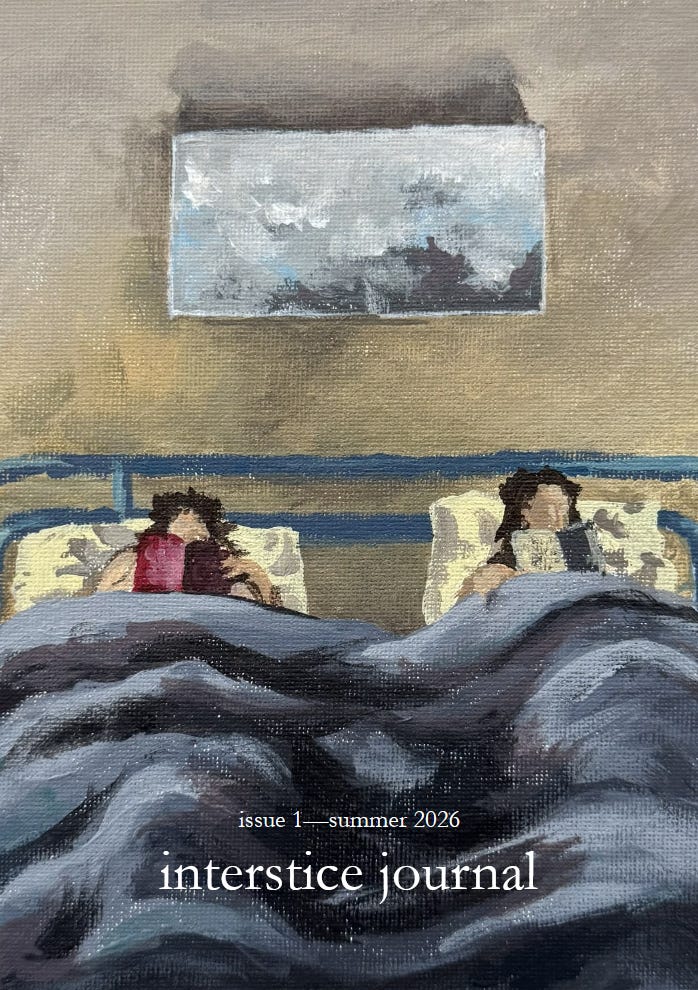
Sierra Whitt is the creative nonfiction editor of Interstice Journal and an oil and acrylic painter based in Flagstaff, Arizona. Her work explores atmosphere, emotion, and the quiet beauty found in everyday moments. Drawn to storytelling through color and texture, she creates paintings that invite viewers to slow down, reflect, and form their own personal connections.
Thank you to all of our supporters who have made this first issue possible! If you’d like to learn more about our journal, read about us here. If you’d like to learn more about how to submit for our next issue, read our submission guidelines here.
this was so beautifully worded. so good. number one fan right here